California Zone 0: What the Adopted 5-Foot Rule Requires
California adopted its Zone 0 rule on August 19, 2026, when the Board of Forestry and Fire Protection voted 8-0 to require an ember-resistant band in the first five feet around structures. It covers State Responsibility Areas and Very High Fire Hazard Severity Zones, roughly two million structures statewide. The package sits with the Office of Administrative Law now, so there is no statewide effective date yet. New construction complies on that date. Existing homes phase in: roofs, gutters, and core tree work immediately, combustible materials and under-deck clearing within three years, attached fences and outbuildings within five.
What Zone 0 Is
Zone 0 is the ember-resistant zone: the area within five feet of a structure, measured out from exterior walls and the roof, plus attached decks, stairs, and pergolas. It is the innermost of California's three defensible space zones. Zone 1 runs from 5 to 30 feet. Zone 2 runs from 30 to 100 feet. EmberSafe Home™ works inside all three, but Zone 0 is where the new obligation sits.
The logic is narrow and specific. Most homes lost in a wildfire do not ignite from a wall of flame. They ignite from wind-driven embers that land and collect at the base of the house, or from something small and flammable sitting right against the wall. Remove the fuel in that five-foot band and you remove the most common path to ignition.
What the Adopted Rule Requires
The adopted text lives in Title 14 of the California Code of Regulations. Four requirements carry most of the work.
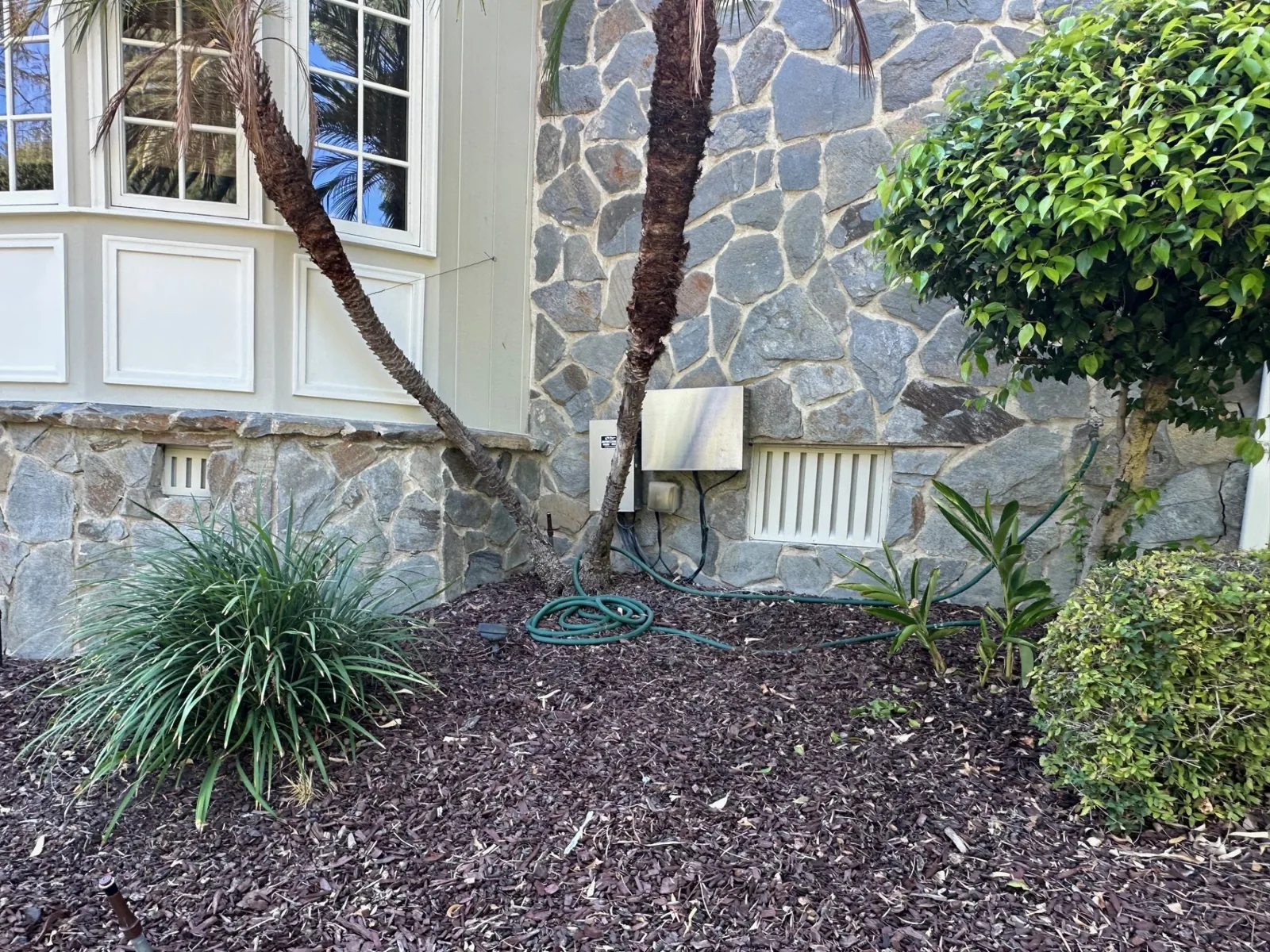
Combustible materials come out of the full five feet. Firewood, bark and wood-chip mulch, dead leaves, pine needles, and stored debris are prohibited. Roofs and gutters must be kept clear, which is where gutter guards earn their place in a compliance plan rather than a maintenance one.
Existing trees may stay, with maintenance. No dead or dying branches. Branches at least ten feet from chimneys. Ladder fuels removed. Clearance kept above roofs and away from walls.
Low, non-woody plants and lawns are allowed in the outer part of the zone. They sit outside a noncombustible safety zone nearest the building. That safety zone flexes with the width of your eave and narrows to a one-foot minimum, with vegetation-free buffers at windows, doors, and attached decks.
Fences and outbuildings get specific treatment. Where a fence or gate attaches to a structure, the first five feet must be noncombustible. New combustible fences and gates are barred within five feet. Outbuildings inside Zone 0 must be noncombustible. That last section of wood fence running into your garage wall is the item most homeowners overlook, and it is the reason fire-resistant fencing is now a code item and not a preference.
The Timeline
New construction complies on the effective date, once the Office of Administrative Law finishes review and the package is filed with the Secretary of State. Existing homes get three tiers.
- On the effective date. Clear roofs and gutters. Complete core tree maintenance: no dead or dying branches, branches ten feet from chimneys, nothing under the eaves.
- Within three years. Remove combustible materials, firewood, and ladder fuels. Clear under decks.
- Within three to five years. Establish the under-eave safety zone. Replace combustible attached fences and gates. Address sheds and outbuildings.
The phase clocks run from the effective date, not from the August vote. Exact calendar dates depend on when the Office of Administrative Law finishes.
What Changed From the Earlier Drafts
The adopted rule is less restrictive than the 2025 and early 2026 drafts, and the difference matters if you read coverage from last year.
Earlier versions read as though the five feet closest to the house had to become bare gravel. The final text does not say that. Established trees can remain under a maintenance standard, and lawns and low non-woody plants are permitted outside the safety zone. The rule leads with education and outreach rather than penalties, and local agencies in incorporated cities may adopt alternative practices that are at least as protective as the state standard.
The direction did not change. The severity did.
Who It Covers
Zone 0 applies in State Responsibility Areas and in Very High Fire Hazard Severity Zones inside the Local Responsibility Area. If your home sits in the foothills or canyons of Los Angeles, Ventura, or Orange County, your address is very likely covered. Check the state fire hazard severity zone maps for your parcel, or look at the cities we serve for local context.
Why Five Feet
The number is not arbitrary. IBHS testing found that an ember-resistant buffer around a home cuts its risk of igniting from a wildfire roughly in half. In side-by-side live fire tests, the home without a noncombustible zone was attacked by embers and burned. The home with one did not ignite.
Zone 0 also works alongside the rest of your defenses rather than replacing them. Embers that find no fuel on the ground still look for a way inside, and the most common opening is an unscreened vent. Ember-resistant vents close that path with fine noncombustible mesh and tested assemblies. A clean five feet and hardened vents cover the two failure points where the data says homes are most often lost.
State officials have also signaled that Zone 0 compliance will tie into the Department of Insurance “Safer from Wildfires” framework, and that Climate Bond funding and CAL FIRE grants are expected to help with implementation.
What We Don't Promise
No contractor can guarantee a home will survive a wildfire. Outcomes depend on wind, fire intensity, neighboring fuel load, evacuation timing, and your home's pre-existing condition. What we promise is measurable risk reduction at the specific failure points where the data says homes are most often lost. Risk reduction is real. Survival guarantees are not.
The same applies to Zone 0 and to insurance. Meeting the rule lowers your home's odds of ignition and keeps you on the right side of the regulation. It does not obligate any carrier to do anything.
How to Get Started
Walk your own five feet. Look at what touches the house: the mulch bed under the windows, the wood fence running into the garage, the firewood by the back door, the debris in the gutter. Most homes have a few easy fixes hiding in plain sight and one or two that need real work.
Plan the three-year and five-year items now, because fence sections and outbuildings are not weekend jobs. Our hardening process page shows how we sequence the work so you spend on what matters first.
Schedule My Free Inspection and one of our EmberSafe team members will be in touch within 24 hours.
Frequently Asked Questions
- Is Zone 0 law in California yet?
- Not yet. The Board of Forestry and Fire Protection adopted the Zone 0 regulations on August 19, 2026 by a unanimous 8-0 vote. The package is under Office of Administrative Law review and must be filed with the Secretary of State before it takes effect.
- What is Zone 0 in California defensible space rules?
- Zone 0 is the ember-resistant zone within five feet of a structure, measured from exterior walls and roof and including attached decks, stairs, and pergolas. It is the innermost defensible space zone and must be kept free of combustible material so wind-driven embers have nothing to ignite.
- Do I have to remove all my landscaping in Zone 0?
- No. The adopted rule allows established trees to remain under a maintenance standard and permits low, non-woody plants and lawns in the outer part of the zone. What must go is combustible material: wood mulch, firewood, dead vegetation, and stored debris.
- When do existing homes have to comply with Zone 0?
- In three tiers measured from the effective date. Roof and gutter clearing plus core tree maintenance are due immediately. Removing combustible materials, firewood, and ladder fuels and clearing under decks is due within three years. The under-eave safety zone, attached fences and gates, and outbuildings are due within three to five years.
- How many California homes does Zone 0 cover?
- Roughly two million structures, in State Responsibility Areas and in Very High Fire Hazard Severity Zones within the Local Responsibility Area. That covers most foothill and canyon neighborhoods in Los Angeles, Ventura, and Orange County.