
Gutter Guards and Wildfire: Why Cleaning Isn't Enough Anymore
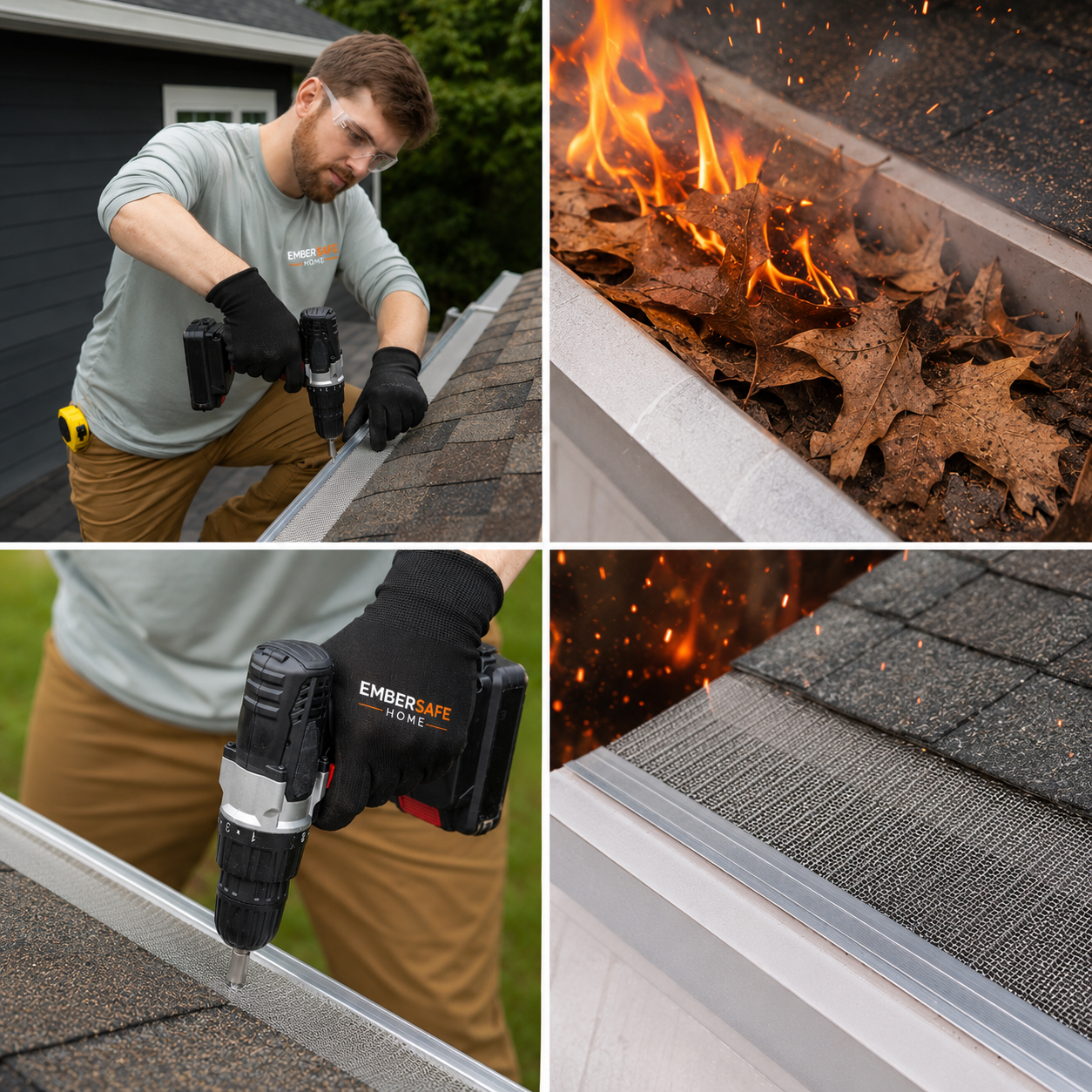
A gutter packed with dry leaves and pine needles is a fuel bed bolted to the edge of your roof. Wind-driven embers land in it, the debris smolders, and flames climb straight into the roof edge, the eave, and the attic. California's Chapter 7A code now requires roof gutters in fire zones to have a means of preventing debris accumulation, and any guard mesh must be noncombustible and corrosion resistant. Cleaning helps for a week. A metal gutter with a metal guard changes the failure point permanently. Vinyl and plastic guards melt, so material matters as much as the guard itself.
Why the Gutter Is a Real Failure Point
The gutter sits at the exact seam where roof, fascia, and eave meet. That seam is already the hardest part of a house to defend, and a full gutter parks concentrated fuel right on top of it.
Here is the sequence that destroys homes. Embers travel ahead of the fire front and land by the thousands. Most die out on noncombustible surfaces. The ones that land in dry needles inside a gutter find exactly what they need: fine, dry, well-aerated fuel. The debris smolders, then flames. Flame at the roof edge attacks the fascia, the first course of roofing, the underlayment, and any exposed eave above it. From there the fire moves under the roof covering or into the attic.
A Class A roof does not save you from this. The rating measures how the covering resists fire from above. It does not account for a sustained flame burning upward at the drip edge from a fire you supplied the fuel for.
What California Code Actually Requires
Chapter 7A of the California Building Code governs construction in Wildland-Urban Interface fire areas. On gutters it is short and specific: roof gutters must be provided with a means to prevent the accumulation of leaves and debris. Where a guard or mesh cover is used, the mesh material must be noncombustible and corrosion resistant.
Two things follow from that language.
First, the requirement is about the assembly, not your Saturday. Code asks for a physical means of prevention, which means a guard, not a maintenance promise.
Second, material is not optional. Noncombustible means metal. Aluminum and steel guards hold up under radiant heat and direct ember contact. Vinyl and plastic guards soften and melt, then drop the debris load they were holding into the gutter or onto the eave.
Confirm whether your parcel falls in a mapped zone using the Office of the State Fire Marshal's Fire Hazard Severity Zone maps. Los Angeles County parcels were remapped in 2025, and many homes moved into higher zones.
Zone 0 Puts the Gutter on the Clock
California's ember-resistant zone, known as Zone 0, covers the first five feet around the structure. The Board of Forestry and Fire Protection has been running the rulemaking, and the drafts have been consistent on one point: roofs and gutters must be kept free of leaves, needles, and debris, and combustible material is not allowed in that five-foot band.
The practical read for a homeowner is simple. Debris in your gutter is a Zone 0 problem, not a housekeeping problem. It is being written into an enforceable standard with a phased timeline, and the early phase is the cheap phase: clear the debris, clean the gutters, get the combustible material out of the first five feet.
For the current rule text and phase timeline, the Board maintains a defensible space zones page, and Cal Fire's home hardening guidance covers the same ground for the rest of the structure.
Why Cleaning Alone Fails
Cleaning is not wrong. It is just not durable.
Fire season in Southern California now runs most of the year, and a single Santa Ana event can refill a gutter under a mature oak or pine in a day. Your gutter is only as clean as the last wind. When ignition depends on the state of your gutter on one specific afternoon you were not home, that is not a control. That is a coin flip.
A noncombustible guard changes the default. The debris stays on top of the mesh, where it is exposed, dries, and blows off, instead of sitting in an enclosed trough against the fascia. Some material still gets through and you still inspect it. The difference is that the worst case, a packed trough of fine fuel at the roof edge, stops being the resting state of your house.
What Good Looks Like
Three things, in order.
- Noncombustible gutter. Steel or aluminum. Vinyl gutters deform and fail under heat and take the debris and the guard down with them.
- Noncombustible, corrosion-resistant guard. Metal mesh or a metal guard system, sized to shed needles rather than trap them. Fine needles are the hard case, and a guard that captures them on top is doing its job only if the load actually sheds.
- A clean five feet. The guard protects the trough. It does nothing about the mulch, dead vegetation, and stored material below it.
Pair the gutter guard work with the Zone 0 clearing and the ember-resistant vents that close the other opening at the same eave. Our hardening process sequences these so the money lands on the failure points first.
What We Don't Promise
No contractor can guarantee a home will survive a wildfire. Outcomes depend on wind, fire intensity, neighboring fuel load, evacuation timing, and your home's pre-existing condition. What we promise is measurable risk reduction at the specific failure points where the data says homes are most often lost. Risk reduction is real. Survival guarantees are not.
The same honesty applies to insurance. Noncombustible gutters and guards appear in the state's mitigation framework and in the IBHS Wildfire Prepared Home standard, and documenting the work strengthens your file. Carriers still make their own underwriting decisions.
Getting Started
EmberSafe™ Home inspects the roof edge, gutters, vents, and the first five feet from the exterior and tells you which failure point on your house is the weakest. No sales theater, no scare tape. See where we work on our service areas page. Schedule My Free Inspection and one of our EmberSafe team members will be in touch within 24 hours.
Frequently Asked Questions
- Does California require gutter guards in fire zones?
- Chapter 7A of the California Building Code requires roof gutters in Wildland-Urban Interface fire areas to have a means of preventing the accumulation of leaves and debris. Where a mesh cover or guard is used, the mesh must be noncombustible and corrosion resistant.
- Can gutter debris really start a house fire?
- Yes. Dry leaves and pine needles in a gutter are fine fuel sitting at the roof edge. A wind-borne ember landing in that debris can ignite it, and the resulting flame exposes the fascia, the roof edge, and the eave directly.
- Are plastic or vinyl gutter guards acceptable?
- No. Plastic and vinyl guards are combustible and can melt under radiant heat, which defeats the purpose and can drop the debris load. Chapter 7A calls for noncombustible, corrosion-resistant mesh, which in practice means steel or aluminum.
- Do gutter guards mean I never have to clean my gutters?
- No. A guard keeps the trough from packing with fine fuel and lets most debris shed off the top. You still inspect the roof, guard, and gutters, especially after wind events and before peak fire season.
- Does hardening my gutters help with insurance?
- Noncombustible gutters and metal debris guards are named in California's wildfire mitigation framework and in the IBHS Wildfire Prepared Home standard. Documented work strengthens your file at renewal. The carrier makes the final decision on your rate and coverage.